
In today’s world, artificial Intelligence is becoming one of the most vibrant technologies. It is because modern tools like AI, computers, and smart systems change the way we live, work, and learn. Learning has become more interactive, faster, and more interesting with the help of artificial intelligence in education.
Hadaf Colleges, a project of Punjab Group of Colleges, has a strong emphasis on modern education to build a strong academic foundation for students. Also, we empower our students to understand technology, use smart tools, and prepare them for the future through a well-equipped computer and robotics lab.
This blog explains everything about artificial intelligence in education, including what it really is, why it is important for students, and how it is used in modern times. Most prominently, we explore how AI is shaping the future of learning and improving education for students around the world.
What is Artificial Intelligence?
Artificial intelligence (AI) is a technology that empowers computers and machines to simulate human learning, understanding, problem-solving, decision-making, creativity, and autonomy. AI tools are built through technologies like machine learning (ML), natural language processing (NLP), deep learning (DL), and computer vision. Applications and devices equipped with AI can
- See and identify objects
- Understand and respond to human language
- Learn from new information and experience
- Make detailed recommendations to users and experts
- Act independently
- Replace the need for human intelligence or intervention
AI is an artificial system developed in computer software, intended to think or act like a human, including cognitive architectures and neural networks. Artificial intelligence is a set of techniques, including machine learning, designed to approximate a cognitive task.
AI offers many benefits across numerous industries and applications. Some of the most common benefits include:
- Automation of repetitive tasks
- Faster insight from data
- Improved decision-making
- Less human errors
- 24/7 availability
- Compact physical risks
Types of Artificial Intelligence
Artificial intelligence can be organised in many ways and is of two types depending on the stages of development or actions being performed.
AI types based on capability
This type defines AI models based on their intelligence level and problem-solving abilities. The models in this type are:
- Artificial Narrow Intelligence (ANI)
- Artificial General Intelligence (AGI)
- Artificial Superintelligence (ASI)
AI types based on functionality
This type classifies AI based on its operation and interactions in specific contexts. The models in this type are
- Reactive machines
- Limited memory
- Theory of mind
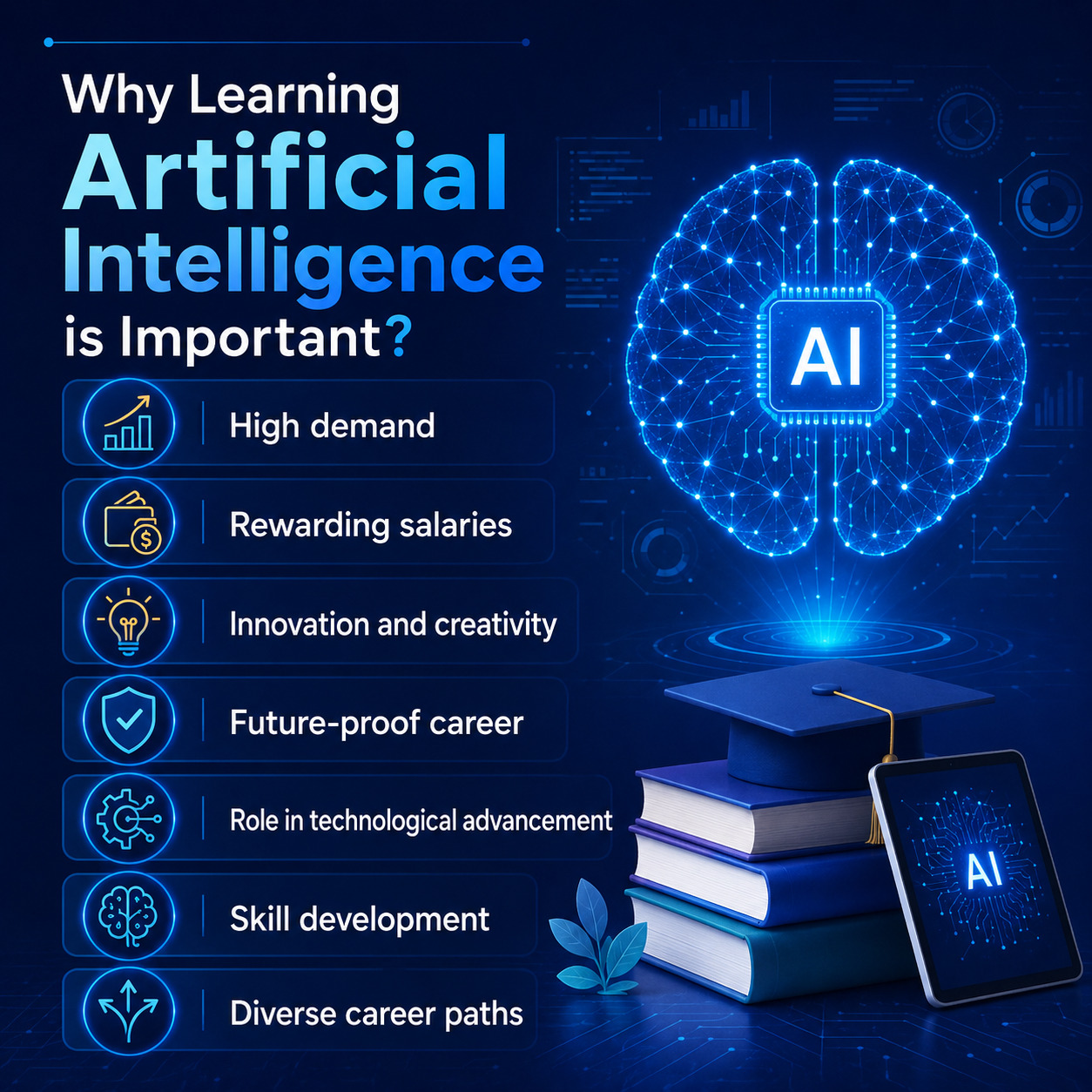
Why Learning Artificial Intelligence is Important?
Below are some reasons to learn Artificial Intelligence
High demand and rewarding salaries
AI Professionals are highly sought after across all industries and sectors due to the ever-growing reliance of society on Artificial Intelligence. This offers good salaries, potential for great career growth, and opportunities in a wide variety of job roles.
Innovation and creativity
With the study of Artificial Intelligence, students get opportunities for experimentation and invention. They can use AI to come up with creative solutions for problems within the tech world or any industry. Also, AI helps in making discoveries that may not have been possible otherwise.
Future-proof career
Due to the high reliance of industries on AI to drive innovation, professionals with AI expertise secure long-term job stability. Also, students stay relevant in an evolving job market. AI also equips them with the tools to adapt and thrive as technology continues to reshape the world.
Role in technological advancement
Artificial Intelligence also has the ability to contribute to technological advancements in all sectors. Students with AI expertise can be part of cutting-edge developments that have a good impact on significant sectors such as healthcare and the economy.
Skill development
Learning AI makes you develop new skills due to its constantly growing and evolving scenario. Students can learn many technical skills like programming, analysing data, and building algorithms that innovate as the sector grows.
While the soft skills like critical thinking, problem solving, and ethics understanding develop as students further advance in their careers. AI learning gives you a wide range of transferable skills that can be applied to infinite career prospects.
Diverse career paths
Artificial Intelligence can be applied to almost any sector, such as healthcare, finance, robotics, and science, where it is used to improve outputs. AI is a combination of computer science, mathematics, and engineering that gives students the chance to explore interdisciplinary work.
Role of Artificial Intelligence in Education
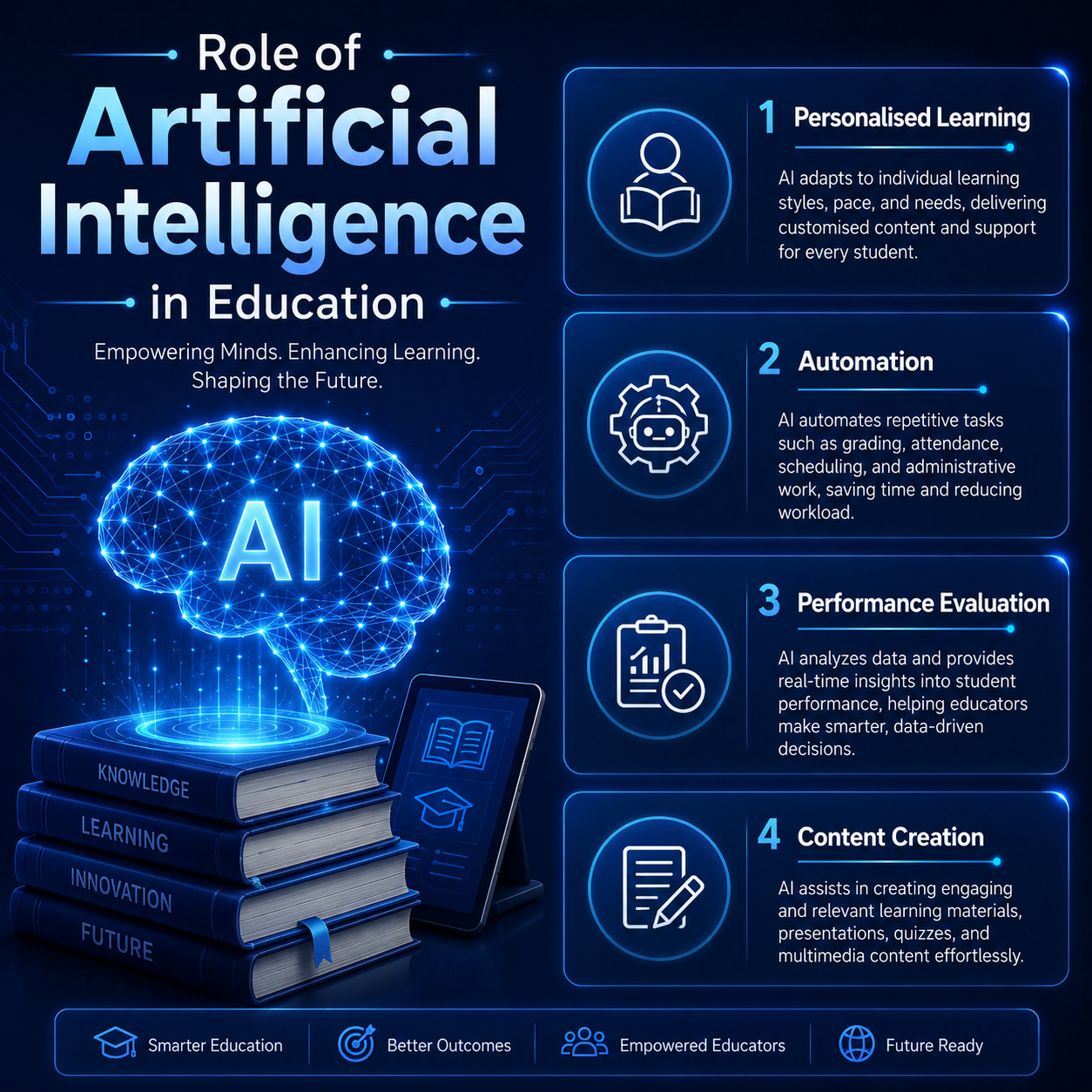
The role of Artificial Intelligence in education is different and reshapes traditional teaching methods. Use of artificial intelligence in modern times, especially in the education sector, has the following prominent roles:
Personalised Learning
Personalised learning is a standout application, as AI examines individual student data to modify educational content, accommodating various learning styles.
Moreover, intelligent tutoring systems, powered by AI, are another application that provides real-time feedback and guidance, offering tailored assistance to students. These systems help in developing an adaptive and interactive learning environment.
Automation
Additionally, workflows for educators can be easily streamlined through AI, which automates administrative tasks, such as grading and attendance tracking. Likewise, virtual assistants, driven by AI, answer student queries, increase accessibility, and offer additional support beyond classroom hours.
Performance Evaluation
Furthermore, artificial intelligence in education continuously monitors student performance, identifies learning gaps, and enables timely interventions through early intervention strategies. This method ensures that students receive the support to become successful and contribute to a more inclusive educational environment.
Content Creation
Another significant aspect of artificial intelligence in education is content creation. It helps in the development of interactive and immersive learning materials. Virtual labs, educational games, and simulations cater to diverse learning preferences, making education more engaging.
Hadaf Colleges and Modern Education
Hadaf Colleges is highly focused on offering quality education to students in Pakistan. Moreover, we help students prepare for future careers through modern learning methods. At Hadaf Colleges, students are encouraged to learn modern subjects, use technology in education, and prepare for both academic success and future careers.
Even though traditional education remains important, modern tools like artificial intelligence in education are equally important for improving the quality of learning. Students need modern skills, digital knowledge, and the ability to adapt to new technologies. This is where Hadaf Colleges play an important role by emphasising ICT, quality education, and student development.
Students are expected to become more independent learners, critical thinkers, and problem solvers with the transformation of education by technology. Hadaf Colleges equips students with the knowledge and skills needed to compete in a technology-driven world. This includes developing digital literacy, analytical thinking, research skills, communication abilities, and an understanding of developing technologies, i.e., Artificial Intelligence (AI).
Moreover, Hadaf Colleges embrace innovation and modern teaching approaches, which help students become
- Future-ready individuals
- Lifelong learners
- Analytical thinkers
- Better researchers
- Adaptable persons
- Problem solvers
- Critical thinkers
- Digitally literate
Begin Your Future with Hadaf Colleges
The future belongs to those students who are ready to embrace new technologies. As artificial intelligence in education continues to transform learning, it is imperative to choose a college that supports academic excellence and modern education.
Visit the official website of Hadaf Colleges to take the next step, whether your goal is higher education, a professional career, or developing future-ready skills.
Conclusion
Artificial Intelligence is transforming education by making learning smarter, faster, and more personalised for students. The benefits of artificial intelligence in education are becoming more visible every day, from improving classroom experiences to helping students learn at their own pace. Students who embrace AI and modern learning tools will have a strong advantage in both education and their careers later. Hadaf Colleges combine quality education with technological awareness to help students build a successful and future-ready path.

