


Nowadays, healthcare is one of the fastest-growing fields in the world. Out of the most important healthcare programmes is BS Radiology. Radiology professionals are needed in every hospital because they know how to operate diagnostic machines to diagnose diseases.
To pursue a degree in radiology in Khyber Pakhtunkhwa (KPK), you need a college that offers a high-quality, accredited, and well-structured BS programme in radiology. Hadaf College of Allied Health Sciences comes forward as a strong choice due to its modern education system, advanced facilities, and academic excellence.
In this blog, we will explore the radiology field in detail and talk about BS radiology and its subjects. Further, we will explain its importance and the benefits of choosing this field. Then, we find out the career aspects of BS radiology and why picking this degree at Hadaf College is good option to build a future in healthcare.
History of Radiology
Radiology first began in Germany in 1895. Wilhelm Conrad Röntgen invented the radiology technique.
The technique uses energised, lightproof cathode ray tube that starts to fluoresce when situated a couple of feet away from a screen painted with fluorescent material. The screen responds to unknown (X-rays) rays. After Röntgen’s discovery, people started creating radiographic images.
What is Radiology?
Radiology is a branch of medicine that diagnoses and treats disease using imaging technology. There are two different areas in radiology: diagnostic radiology and interventional radiology. The professionals who specialise in the radiology field are called radiologists.
Diagnostic Radiology
It helps healthcare providers or radiologists to see structures inside your body using different tests. Diagnostic radiologists specialise in the interpretation of diagnostic images. They often diagnose the causes of symptoms, monitor body response to treatment, and screen for different illnesses.
The common tests for diagnostic radiology include:
- Computed tomography (CT)
- Fluoroscopy
- Magnetic resonance imaging (MRI)
- Magnetic resonance angiography (MRA)
- Mammography
- Bone scan
- Thyroid scan
- Thallium cardiac stress test
- X-rays
- Positron emission tomography
- Ultrasound
Interventional Radiology
It helps radiologists to help guide procedures using imaging such as CT, ultrasound, MRI, and fluoroscopy. This involves smaller or no incisions (cuts) and is helpful for doctors when inserting catheters, wires, and other small instruments and tools into a patient’s body.
Interventional radiologists are involved in the treatment of cancers or tumours, arterial and venous blockages, fibroids in the uterus, back pain, liver problems, and kidney problems. Some of the procedures of interventional radiology include:
- Angiography
- Angioplasty
- Stent placement
- Embolization
- Radiofrequency ablation, cryoablation, or microwave ablation
- Vertebroplasty and kyphoplasty
- Needle biopsies
- Breast biopsy
- Uterine artery embolization
- Feeding tube placement
- Catheter placement
How do Radiologist Work?
- A radiologist uses and manages the machines to produce an image.
- Then, they look at the outcome of a certain imaging test and interpret it to evaluate and support a diagnosis.
- The radiologists will give reports of their interpretations to the referring clinical doctors after a patient undergoes imaging tests.
BS Radiology at Hadaf Colleges
Hadaf College of Allied Health Sciences offers many BS programmes, one of which is a 4-year BS degree programme in radiology. This degree programme involves the learning of a medical discipline that uses medical imaging to diagnose diseases and guide their treatment in humans.
The curriculum of the Bachelor of Science in Radiology is very extensive, knowledge-oriented, and provides hands-on experience to students. Moreover, students during this programme learn about imaging modalities such as ultrasound, computed tomography (CT), magnetic resonance imaging (MRI), fluoroscopy, and positron emission tomography (PET).
The details, including programme structure, fees, and subjects of the BS Radiology programme at Hadaf Colleges, are given here: BS in Radiology at Hadaf Colleges.
Why is Radiology Important?
As we discussed above, radiology helps in disease diagnosis and treatment, particularly cancer. In that case, early diagnosis can save the lives of patients diagnosed with cancer. Likewise, doctors and emergency care physicians cannot manage patients without diagnostic imaging effectively. In short, there will be no cure or treatment without a diagnosis.
According to one study in Ontario, an average of eight people will be diagnosed with cancer, and three will die from cancer every day. Moreover, radiology is important in healthcare because of:
- Prevention and screening
- Treatment and therapy
- Informing the public
- Staying ahead in technology and medicine
- Tracking and evaluating
Also, radiology is important because it is required in every sector within the healthcare field, such as surgery, paediatrics, obstetrics, oncology, trauma-response, emergency medicine, and infectious disease. That is why they rely on radiology to find the right diagnosis and course of treatment.
Benefits of a Radiology
Radiology has transformed modern healthcare by providing fast, accurate, and non-invasive diagnostic tools. Moreover, it plays a vital role in improving patient outcomes by assisting in early detection, monitoring, and treatment of diseases.
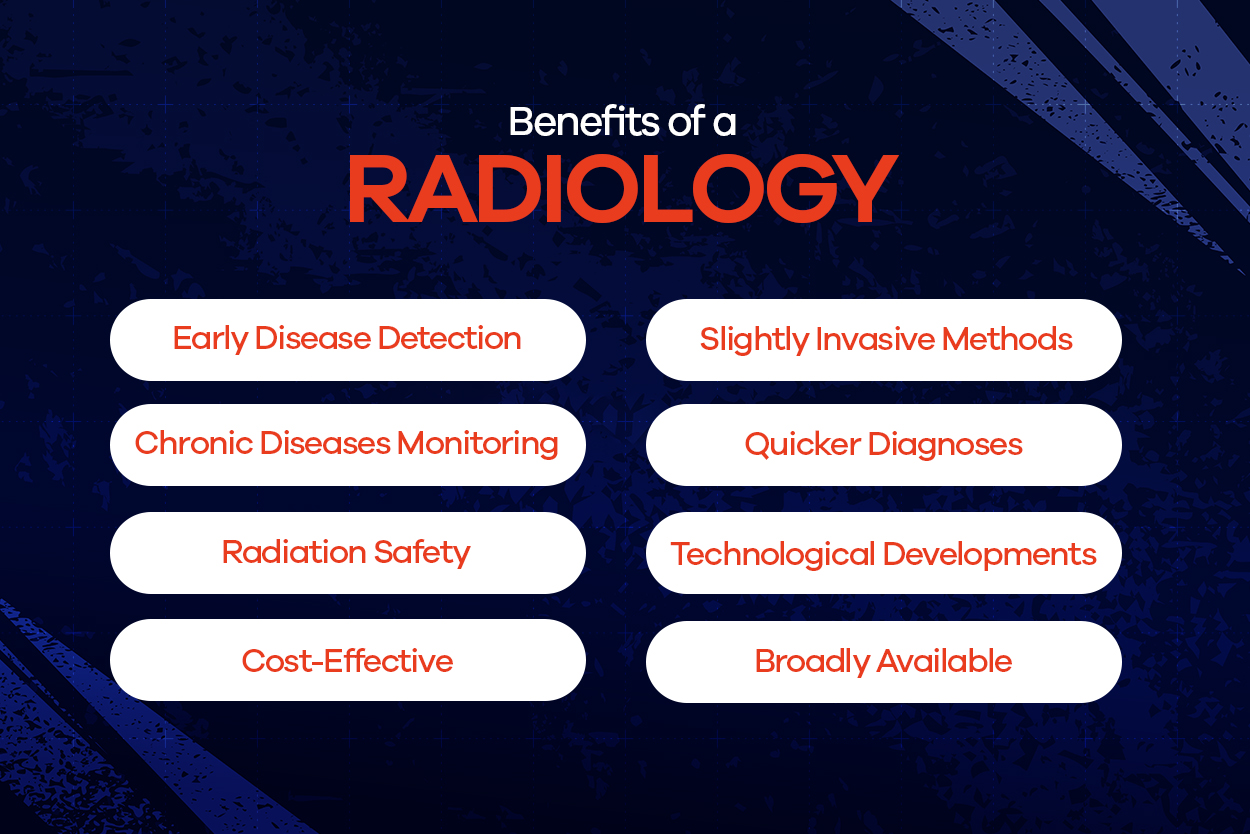
You can only appreciate radiology importance in medical care when you understand its benefits, given below:
Early Disease Detection
- Prevents Disease Progression
- Improves Survival Rates
- Helps in Preventive Healthcare
Exact and Comprehensive Diagnoses
- High-Resolution Imaging
- Multiple Imaging Options
- Guides Medical Decisions
Slightly Invasive Methods
- Reduces Need for Exploratory Surgery
- Guides Surgical Planning
- Assists in Biopsies and Tumour Ablation
Greater Chronic Diseases Monitoring
- Tracks Disease Progression
- Adjusts Treatment Plans
- Improves Patient Outcomes
Quicker and Effective Diagnoses
- Emergency Imaging
- Reduces Hospital Stays
- Enhances Patient Safety
Radiation Safety and Hi-tech Developments
- Low-Dose Radiation Technology
- AI-Assisted Imaging
- Portable Imaging Solutions
Cost-Effective and Broadly Available
- Prevents Expensive Treatments
- Widely Accessible
- Covered by Most Insurance Plans
Career Aspects of Radiology BS Degree
Radiology professionals have an opportunity to work both as part-time and full-time medical professionals, in
- Private and government hospitals
- Imaging centres
- Diagnostic laboratories
- Other healthcare facilities
The job profiles linked with the BS degree in Radiology are:
- Radiology Technician
- MRI Technician
- Radiographer
- Radiology Assistant
- Ultrasound Technician
- Academician
- Researcher
- Medical Writer
Opening a radiology clinic or imaging centre requires a large investment in the form of high-priced technological machines and equipment. But this field is still worth it because radiology has become one of the highest-paying medical specialties.
Why Hadaf College of Allied Health Sciences is Best for BS Radiology?
If you want to study healthcare in KPK, then the BS radiology degree at Hadaf College of Allied Health Sciences is the wise choice. This is so because Hadaf Colleges have purpose-built campuses in Peshawar, Charsadda, and Swabi, providing quality education and facilities to students.
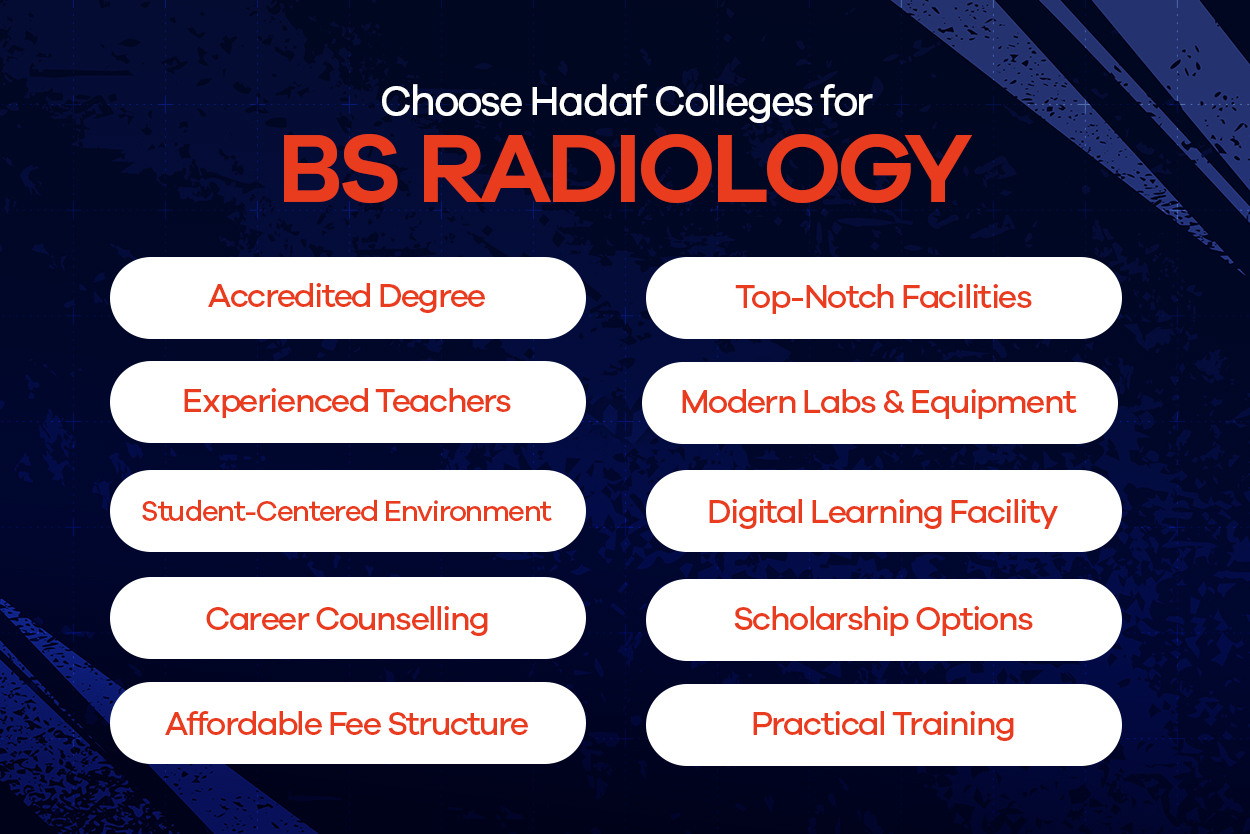
Moreover, pursuing a BS Radiology Degree at Hadaf College of Allied Health Sciences provides numerous advantages, such as:
- Accredited Degree Affiliated with Khyber Medical University (KMU)
- HEC Approved Programme
- Top-Notch Facilities
- Experienced Teachers
- Modern Radiology Labs & Equipment
- Safe & Student-Centered Environment
- Smart Classrooms & Digital Learning
- Career Counselling & Guidance
- Scholarships & Affordable Fee Structure
- Practical Training & Hospital Exposure
Become a Qualified Radiologist at Hadaf Colleges
With BS Radiology at Hadaf College of Allied Health Sciences, you will receive the best education and facilities at Hadaf Colleges to build a solid foundation for your healthcare career.
APPLY NOW for admission to Hadaf College of Allied Health Sciences. Make yourself ready to get an accredited and top-ranked degree to become a skilled radiology professional.
Conclusion
BS Radiology provides you chance to start your bright and confident future in hospitals and medical centres. Moreover, it is a powerful and growing field that opens doors to handling advanced medical machines and healthcare careers. BS Radiology at Hadaf College of Allied Health Sciences provides a perfect environment to succeed with its modern facilities, expert teachers, and supportive learning environment.
FAQ’s
What is BS Radiology?
BS Radiology is a 4-year degree where students learn to use imaging machines to help diagnose and treatment of diseases.
Is the BS Radiology degree recognised?
Yes, it is HEC-approved and affiliated with Khyber Medical University.
Do students during this degree get practical training?
Yes, students get practice on real imaging equipment and have hospital exposure.
Is BS Radiology good for girls?
Yes, it is appropriate for both boys and girls. Moreover, it has high job demand for everyone.
What are the entry requirements for BS in Radiology?
Students need an intermediate qualification, FSc Pre-Medical, to apply for this degree programme.

