


Artificial Intelligence is changing the way people study, work, communicate, and solve problems. This change creates a great opportunity for intermediate students. If you are inquisitive about which AI Skills to learn in 2026, you are in the right place.
Hadaf Colleges, one of the leading projects of Punjab Group of Colleges, understands the importance of preparing students for a changing world. Intermediate education is not only about passing exams, but it is also about developing useful skills that can help students in higher education, future careers, and everyday life.
This article explores different types of AI skills to learn in 2026 and why these skills matter. Further, we explore how Hadaf Colleges help students develop these skills to support their future academic learning and careers.
What are AI Skills?
Learning AI does not always mean writing difficult computer programmes. But it also means knowing how to ask useful questions, check information, understand data, solve problems, protect personal information, and use technology responsibly.
AI skills help anyone comprehend, build, and interact with AI tools. AI skills are modular and reusable capabilities that define how an AI agent performs a particular task. People need practical experience along with knowledge to take full benefit of digital labour.
Nowadays, developing AI skills in 2026 involves deeply understanding how AI tools think, such as what data they use to reach conclusions and how they make decisions.
AI is no longer limited to scientists, software engineers, or large technology companies. But students can now use AI tools to research topics, organise information, and improve writing. Further, AI can also help students create presentations, understand difficult concepts, analyse data, and explore new ideas.
Understanding AI can help students prepare for the future, whether they are interested in computer science, business, medicine, engineering, design, education, or any other field. Students do not become AI experts overnight, but they can start early by learning basic AI skills.
Types of AI Skills
AI skills are divided into two broad categories: technical skills and non-technical skills.
Technical AI Skills
These skills are essential to build and sustain AI systems. They include algorithm building, testing, and execution tools across business networks, using knowledge of programming languages such as Python or Java.
Non-Technical AI Skills
They don’t need to build AI systems but need to work effectively with AI. These skills help individuals interact with AI. Moreover, non-technical skills will become even more essential in the future.
Example: One example is prompt engineering, which does not involve building code that runs complicated AI architecture. In actually, it is about enlarging AI’s capabilities by asking the right questions to get more precise answers.
Why AI Skills Matter?
From education and healthcare to business, engineering, software development, and media, AI is becoming a useful part of many fields. AI skills to learn in 2026 can become an important part of career readiness, especially for intermediate students.
Moreover, the fast growth of AI use, from AI chatbots to digital workers across various businesses, shows the high demand for both technical and nontechnical AI skills for AI-related jobs. Students who start learning basic AI skills at an early stage can better understand how modern technology works and how it can be used in different fields.
According to the Future of Jobs Report 2025 by the World Economic Forum, AI and big data are among the fastest-growing skill areas anticipated to become more important in the coming years. The report also highlights analytical thinking, creative thinking, curiosity, resilience, flexibility, and lifelong learning as important skills for the future. Below are the reasons AI skills to learn in 2026 matter:
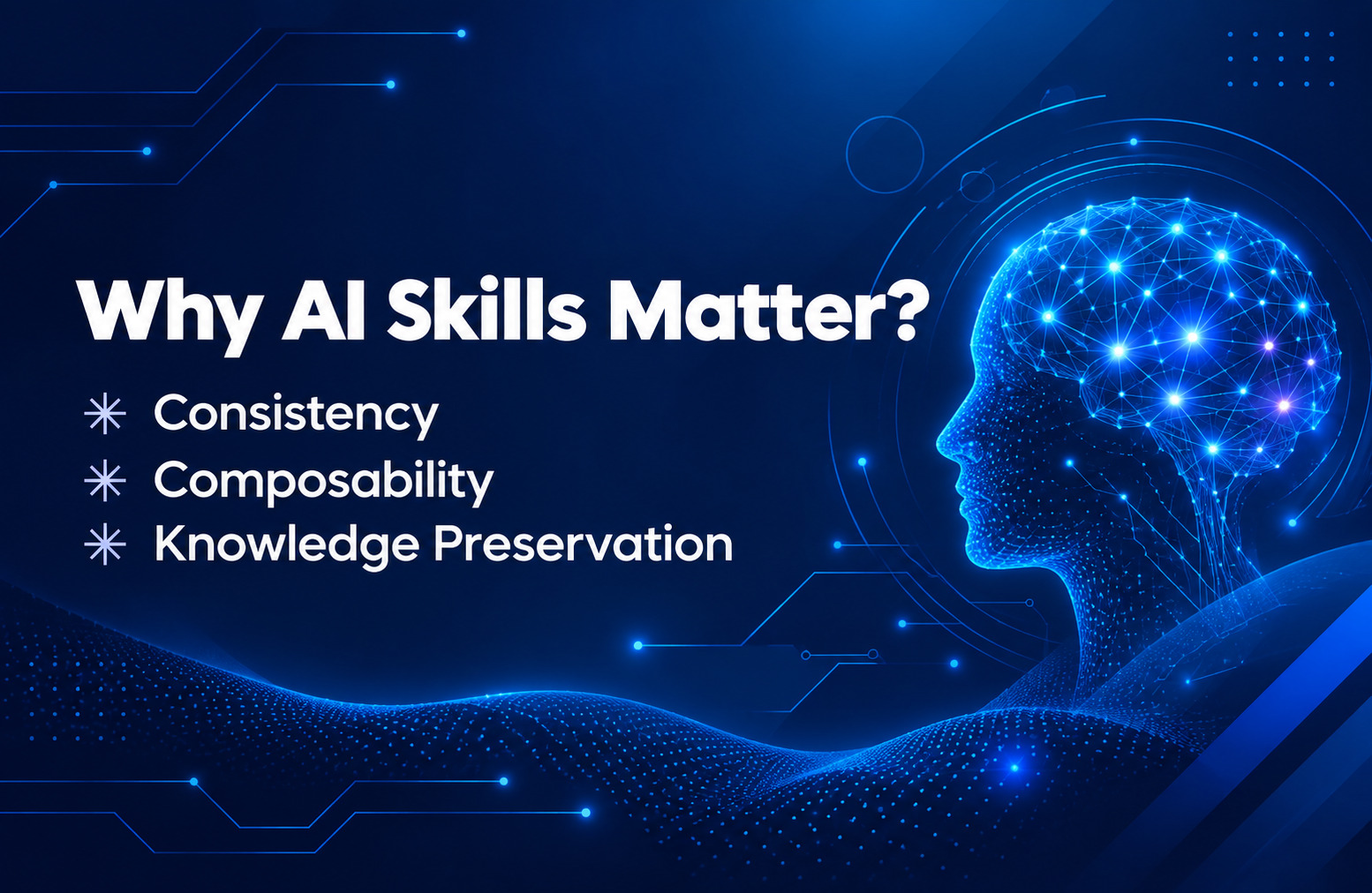
Consistency
AI behaviour varies between sessions in the absence of specific skills. These skills ensure the same process is followed every time
Composability
Skills can chain together. A build feature workflow might appeal to brainstorming skill (explore requirements, TDD skill (write tests first), implementation skill (write code), and code review skill (verify quality)
Knowledge Preservation
Skills capture team expertise in a transferable format. In this way, new team members (human or AI) can instantly follow established practices.
So, AI skills to learn in 2026 represent a shift from talking to AI to programming AI behaviour. They bring software engineering principles such as modularity, reusability, and testability to AI interactions. These skills will be the building blocks that make AI agents more capable and truly useful in professional workflows.
Top Technical AI Skills to Learn in 2026
The top technical AI skills to learn in 2026 help in structuring and sustaining AI models. In 2026 and onwards, there are many roles of AI that require technical skills to get the job done. Here are four of them:
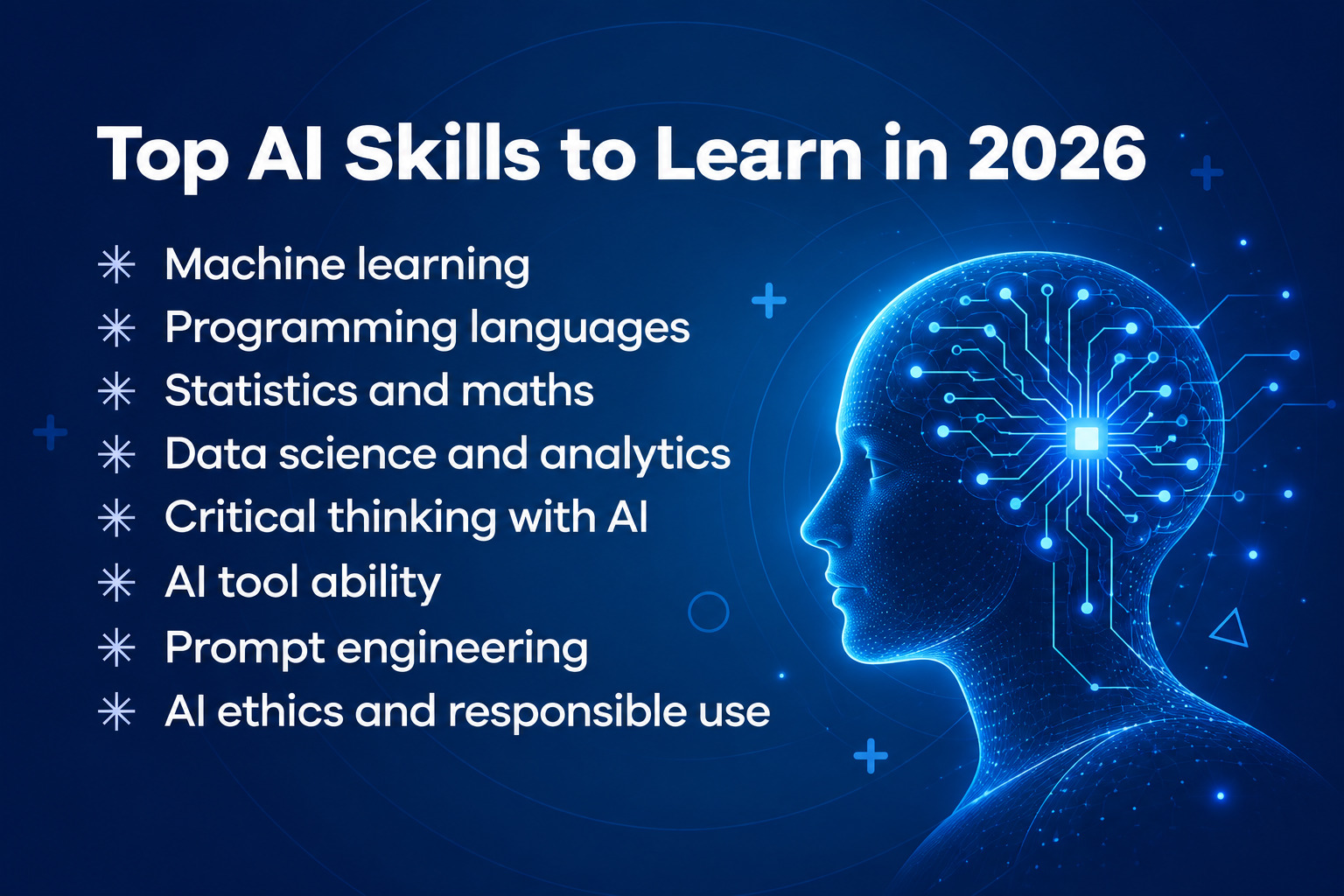
Machine learning
The making and testing of algorithms that support AI tools is called Machine learning. Key skills include forming learning models and mastery of multiple training formats i.e., supervised, unsupervised, and reinforcement learning.
Programming languages
Likewise, programming languages play an integral role in building AI tools. Some of the programming languages are Java, Python, C++, Julia, or Scala. Moreover, AI programming skills also include the use and integration of natural language processing (NLP) and large language models (LLMs).
Statistics and maths
Statistics and mathematical models are also two other main components of effective AI. Both models help in reaching the right conclusions and identifying the factors that led to these conclusions.
Data science and analytics
Data experts play a key role in developing accurate and reliable AI models that can improve AI transparency. This skill set includes the sources that AI tools use, what decision-making models are applied, what conclusions are reported, and checking the accuracy. One study finds that 92% of analytics and IT leaders feel the need for trustworthy data.
Top Non-Technical AI Skills to Learn in 2026
There are many other AI skills that help non-technical people to get the most from AI tools. Here are five other non-technical AI skills to learn in 2026:
Critical thinking with AI
AI remains a primarily human experience where tools are modeled on human decision-making. This means human perception is vital to help understand AI behaviour, which ultimately requires critical thinking skills.
AI tool ability
It takes time and practice to learn how to maximise the results. So, getting familiarity with multiple tools related to research, analytics, customer service, writing, and design can make you a useful asset for organisations that are integrating AI into their operations.
Prompt engineering
As we know, AI excels at content but struggles with context. So, it needs clear, concise, and unambiguous prompts that help get the best and most accurate answers from AI. Prompt engineering is the practice of filtering AI queries to get better answers quickly.
AI ethics and responsible use
AI ethics and responsible use are at the forefront due to the continuous evolution of AI standards and regulations. Future businesses need specialists to help them limit the bias risk, ensure the accuracy of data sources, and prioritise data privacy.
How Hadaf Colleges Helps Students Prepare for the Future?
Hadaf Colleges provides students with an academic atmosphere where they can build knowledge along with the skills needed for further education and future careers.
For students interested in technology, the FCS/ICS programme at Hadaf Colleges can provide a useful foundation for technical AI skills in the form of computer-related concepts. Also, BS Computer Science at Hadaf Colleges allows students to continue developing their technology knowledge after intermediate education.
For intermediate students, developing future-ready skills is not only about learning technology. But they also need to develop communication, critical thinking, creativity, mathematics, and problem-solving skills. This is because these skills can help them understand new technologies and adapt as technology continues to change.
Start Building Your Future with Hadaf College
The AI skills to learn in 2026 can help students prepare for a tomorrow where technology is part of education and many careers. At Hadaf Colleges, students can build a strong academic foundation while developing skills such as computer knowledge, problem-solving, critical thinking, and communication.
You can visit our official website for more information regarding programmes, facilities, scholarships, and more.
Conclusion
The future of education and work is closely connected with technology, making the AI skills to learn in 2026 valuable for today’s students. For intermediate students, starting with basic AI skills can create a strong foundation; then learn step by step, practice regularly, and use AI responsibly. Furthermore, students can build useful skills for an increasingly technology-driven future with the right education and a willingness to keep learning.


