The matric result is soon to come out, and if you want to open the door to a wide range of exciting opportunities in the technology sector, then selecting an Intermediate in Computer Science (ICS) is one of the smartest decisions.
As the digital world continues to evolve, Hadaf Colleges offers an intermediate in computer science (ICS) with the name (FCS) to give students both theoretical knowledge and practical computer skills. We believe that students with a strong foundation in FCS are well-positioned to explore emerging technologies and build successful careers.
This article critically explores the modern trends after completing the intermediate in computer science. Later, we explore how Hadaf Colleges equips students for success in the digital era. Let’s start together!
What are Modern Trends?
Amid constant change and rapid technological advancement, trends have become the heart of modern society. Trends put forward new ideas and opportunities, break the boundaries of the market, and allow businesses to interconnect their values in a diverse manner.
The intersection of hyper-personalisation, artificial intelligence integration, and mindful living defines modern trends. The current article prioritises digital innovation and focuses on the modern trends in computer science discussed in the next section.
Modern Trends in Computer Science
We are well aware of the fact that the computer science industry is continuously changing the world every day. Likewise, new apps, smart devices, robots, and artificial intelligence are becoming a part of our daily lives. These new emerging technologies are revolutionising business operations, communication, and data management across industries.
The emergence of these advanced trends makes computer science one of the most exciting fields for students. Understanding these trends helps students choose the right academic path and prepare for future careers in the computer and IT field. Some of the modern trends in computer science that are set to change the world are as follows:
Artificial intelligence (AI) and machine learning (ML)
Artificial intelligence (AI) will significantly shape the 21st century. It represents an innovation that integrates the entirety of human knowledge into a single system. No area of computer science has involved more investment or media attention than AI and machine learning (ML).
AI empowers computer systems to accomplish tasks from reasoning and pattern recognition to language understanding needing human intelligence. Whereas ML systems learn from data, improving their outputs over time without being openly reprogrammed.
According to the U.S. Bureau of Labor Statistics, computer and information research scientist jobs, that includes AI researchers, will grow 23% from 2022 to 2032. The influence of both AI and ML is accelerating, and both have applications in healthcare, finance, education, and business.
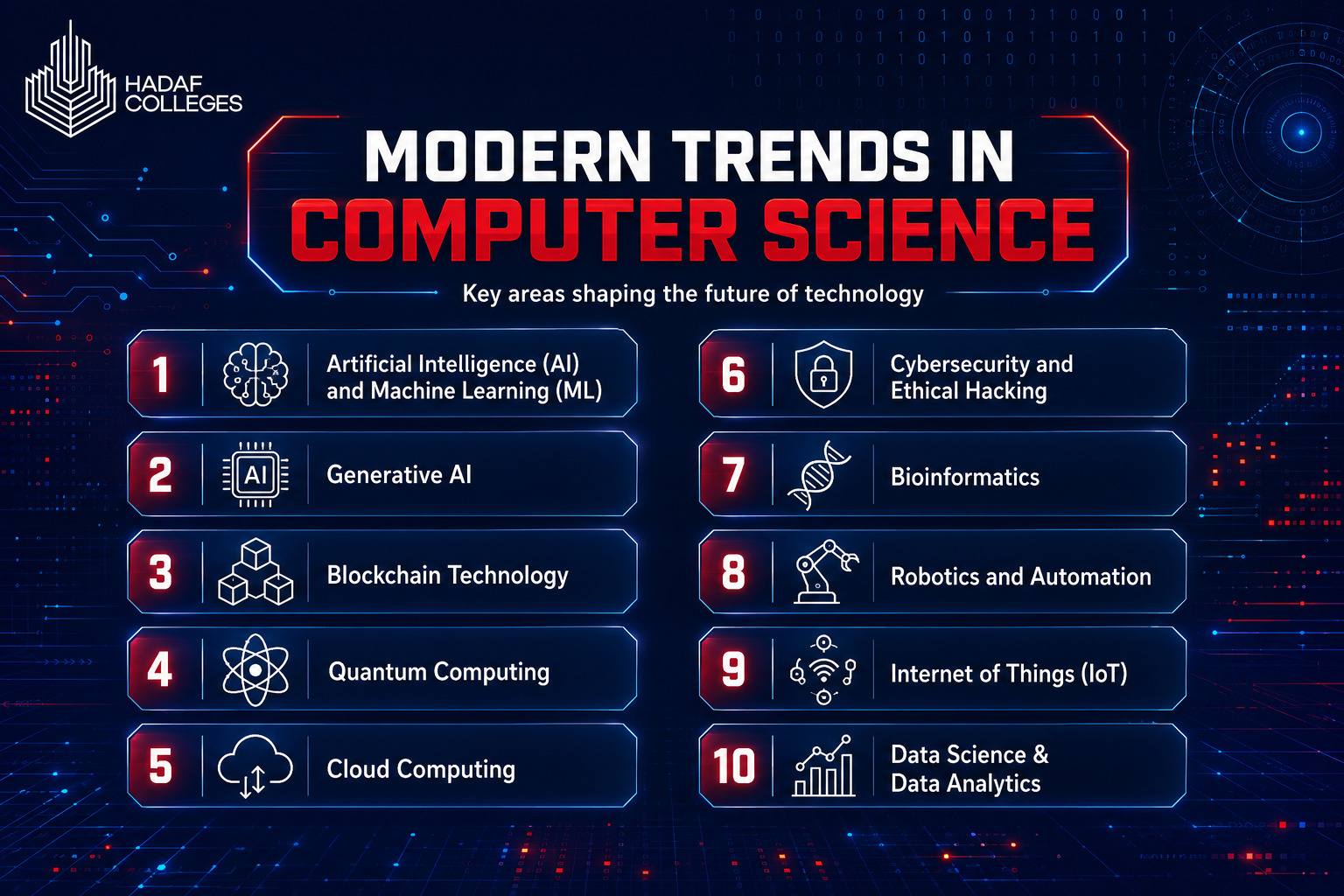
Generative AI
Where traditional AI systems were built to classify, predict, or recommend, Generative AI is an advanced type of AI. This can create new content, such as articles, images, codes, audio, videos, and synthetic data generated from learned patterns.
Generative artificial intelligence (AI) models can summarize and classify information or answer questions. This is because they have been trained to recognise patterns in data.
It is one of the most significant trends in computer science today because of its applications in drug discovery, disease detection, fraud detection, report automation, personalized learning, content creation, and software development.
Blockchain technology
A decentralized digital database that connects encrypted data blocks across a network so that no single party controls it is established through blockchain technology in computer science. This decreases the reliance on third parties and makes records resistant to tampering.
Quantum computing
Quantum computing solves problems that are not solved by conventional computing. It is powerful, fundamentally different, and extraordinarily fast, using quantum bits to represent multiple values simultaneously. Also, it operates on subatomic particles rather than a stream of binary impulses, and its bits, called qubits.
Moreover, it has the potential to transform cryptography, optimization, and scientific modelling, thus making it a highly specialised field. According to a report in March 2024, quantum computing professionals earn an average annual salary of $131,240.
Cloud computing
Cloud computing is on-demand access to computing resources, both physical and virtual servers, data storage, networking capabilities, application development tools, software, and AI-powered analytic platforms. It is an internet-based service with pay-per-use pricing.
It has primarily changed how individuals and businesses store, access, and manage data. It also helps them to deliver infrastructure, platforms, and software. Moreover, it frees companies from the restrictions of local hardware.
Cybersecurity and ethical hacking
Cybersecurity refers to protecting digital assets from cyberthreats. AI-powered security tools can detect and respond to threats in real time due to the growing cyber threats in frequency and sophistication. The U.S. Bureau of Labor Statistics stated that information security analyst jobs will grow 32% from 2022 to 2032.
Ethical hacking, an essential defensive discipline, is a lawful practice of probing systems and networks to classify vulnerabilities before malicious attackers can exploit them. It operates entirely legally to improve an organization’s overall security posture. Most attacks are made to access or change information, extort money, or disturb business.
Bioinformatics
Bioinformatics combines biology with computer science. It generally focuses on data collection and analysis. Biologists use bioinformatics tools and techniques to spot patterns in their data, e.g., genome sequencing of organisms.
Bioinformatics specialists have cluster analysis, algorithm development, server cluster management, and protein sequencing analysis skills. It is estimated that bioengineering and biomedical engineering jobs will grow 5% from 2022 to 2032, according to U.S. Bureau of Labor Statistics.
Robotics and automation
Modern ML-powered robots can perceive and adapt to their environments. They handle dangerous or precision tasks in manufacturing, logistics, and health care with a high level of speed, accuracy, and consistency that human operators cannot match.
Robotic process automation (RPA) are software robotics that automate rule-based digital workflows in finance, HR, and customer support. It does not require changes to existing systems and uses intelligent automation technologies to perform repetitive office tasks of human workers. The tasks include data extraction, form filling, file moving, and much more. This robotic automation is timesaving, reduces errors, and frees teams to focus on higher-value work.
Internet of Things (IoT)
IoT connects everyday devices to the internet, thus empowering them to collect and exchange data. Also, it extends internet connectivity beyond traditional computers to physical devices and everyday objects. IoT devices are nonstandard computer hardware equipped with sensors and processors that autonomously collect, transmit, and exchange data.
This technology enables deep automation, remote monitoring, and real-time analytics across consumer and industrial environments. Some common examples of IoT technology are smart homes, wearable devices, and connected vehicles.
Data science and big data analytics
Data science is the field of study that uses scientific methods, algorithms, and statistical models to extract knowledge and insights from complex datasets. Data science and big data analytics driving innovation and better decision-making across every sector.
It is an interdisciplinary field that combines expertise from statistics, computer science, mathematics, and domain-specific knowledge. This makes it amazingly adaptable, with applications in healthcare, finance, marketing, and environmental research.
Intermediate in Computer Science at Hadaf Colleges
At Hadaf Colleges, the Intermediate in Computer Science is a two-year intermediate programme. This programme builds strong computational and technological skills to prepare students for higher education and modern careers in the digital world. Admissions are OPEN NOW!
During an intermediate in computer science at Hadaf Colleges, students learn programming, web development, databases, and many other important topics that prepare them for modern careers. The compulsory and elective subject combinations during intermediate in computer science are as follow:
Compulsory Subjects
- English
- Urdu
- Islamic Studies
- Pakistan Studies
Elective Subjects
- Physics-Mathematics-Computer Science
- Statistics-Mathematics-Computer Science
- Statistics-Economics-Computer Science
Important Note: Students have to opt for any one of the following elective subject combinations shown above.
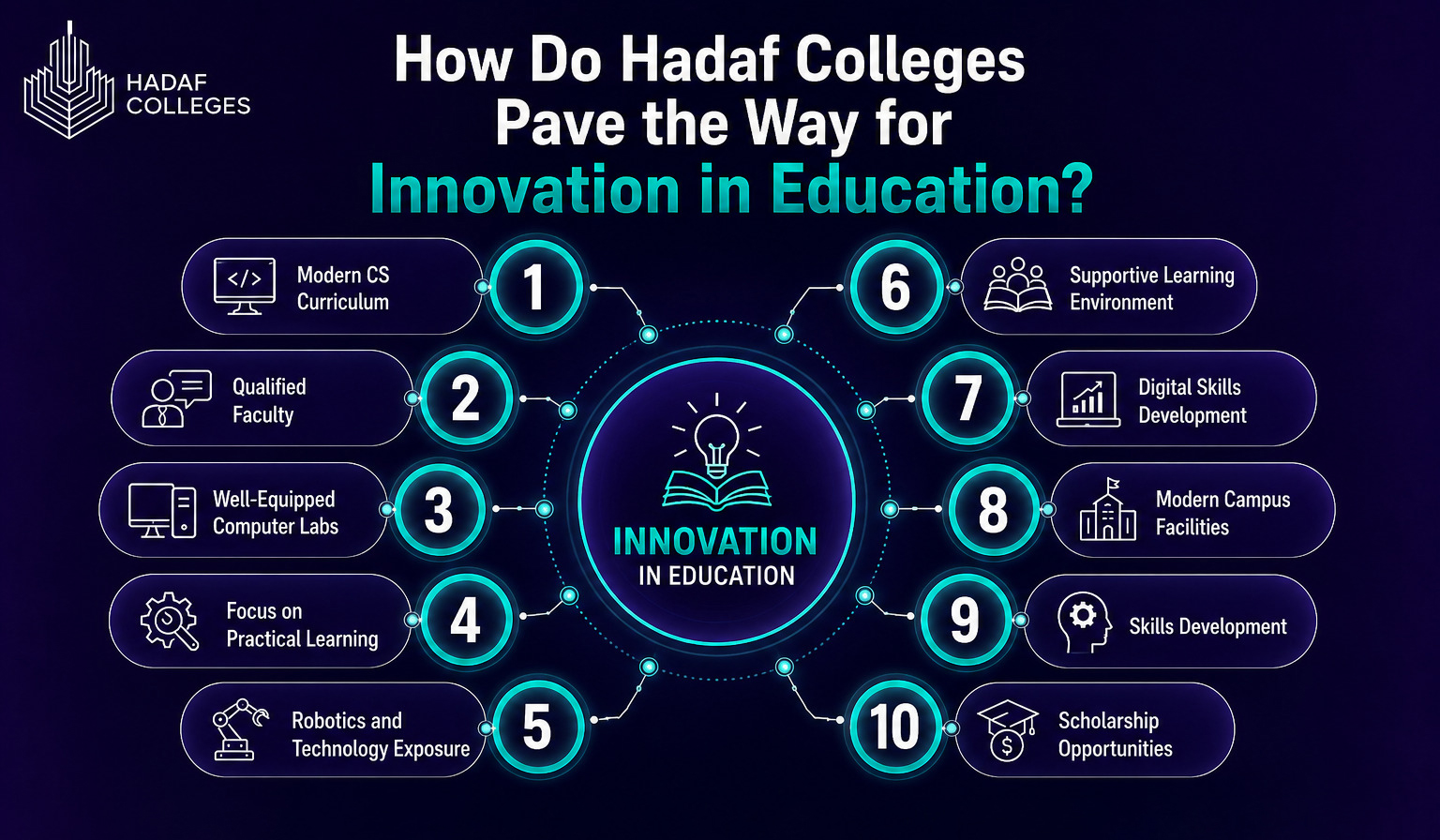
How Do Hadaf Colleges Pave the Way for Innovation in Education?
Hadaf Colleges help students stay ahead of new trends in technology and education by combining quality teaching, modern facilities, and practical learning. We prepare students with the knowledge, skills, and confidence they need to succeed in a fast-changing world through our FCS programme.
Through FCS/ICS programme, here are some ways Hadaf Colleges foster innovation in education:
- Modern CS Curriculum
- Qualified Faculty
- Well-Equipped Computer Labs
- Focus on Practical Learning
- Robotics and Technology Exposure
- Career-Oriented Programme
- Supportive Learning Environment
- Digital Skills Development
- Modern Campus Facilities
- Skills Development
- Scholarship Opportunities
Get Yourself Ready to Build Future in Technology?
An intermediate in Computer Science at Hadaf Colleges helps get practical skills, expert guidance, and a strong academic basis to excel in a technology-driven world. Intermediate Admissions 2026 at Hadaf Colleges are now OPEN.
Apply today for the Intermediate Admissions 2026 at Hadaf Colleges. Start shaping your future toward a successful career confidently with us.
Conclusion
Picking an Intermediate in Computer Science is a smart step to build a successful future in technology. At Hadaf Colleges, students can unlock countless academic and career opportunities with the right education, practical skills, and exposure to modern trends in computer science. Quality education, experienced faculty, and modern learning facilities during our FCS programme help students to grow and move towards a rewarding career in the ever-evolving world of computer science.


